

Clear aligners straighten teeth using a series of custom-made, removable trays instead of brackets and wires. They are nearly invisible, they come out for meals, and for the right case they work just as well as braces. The question most people actually want answered is a narrower one. Am I a candidate for clear aligners, or is my case the kind that needs something fixed in place?
At Klein Walker & Weber Orthodontics, Dr. Klein, Dr. Walker and Dr. Weber answer that at a first visit, and the answer is more specific than most people expect. Here is what goes into it.
What Are Clear Aligners?
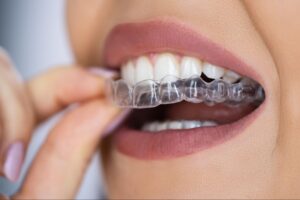
Clear aligners are an orthodontic treatment that gradually straightens teeth using a series of custom-made, removable trays. These trays fit snugly over your teeth and gently shift them into the desired position over time. They are made from smooth transparent plastic, so you can keep your smile looking much the same throughout treatment.
Benefits of Clear Aligners:
- Discreet appearance: Clear aligners are almost invisible, which makes them a good choice for anyone who prefers a subtle approach to orthodontic treatment.
- Comfortable fit: Made from smooth plastic, they are designed to minimize irritation and fit comfortably over your teeth.
- Convenience: Because they are removable, you can take them out for eating, brushing and flossing, so your normal routine barely changes.
Who Can Benefit from Clear Aligners?
Clear aligners are a versatile option that suits many orthodontic needs. They work well for mild to moderate alignment issues, which makes them a popular choice for teens and adults alike.
Common issues clear aligners address:
- Mild to moderate crowding: If your teeth are slightly crowded or overlapping, clear aligners can gently move them into the proper position.
- Gaps between teeth: Aligners close spacing, creating a more uniform and aligned smile.
- Minor bite issues: Aligners help with slight overbites, underbites and crossbites, improving both the function and the appearance of your bite.
- Teeth that shifted after previous treatment: Relapse cases are often straightforward and finish faster than a first round of treatment.
Age considerations: Clear aligners suit older teens and adults who have the discipline to wear them consistently. Because the trays come out, results depend on the person wearing them as prescribed rather than on the appliance alone.
When Clear Aligners Are Not the Right Fit
Being honest about this matters more than the sales pitch. Some cases genuinely do better with braces, and starting in aligners when your case calls for brackets usually means a longer road and a compromised result.
Aligners are generally not the first choice when you have significant crowding that needs teeth rotated substantially, a bite discrepancy large enough to need elastics working against fixed anchors, teeth that need to move vertically rather than tip, or a young patient still in mixed dentition where growth has to be guided.
Wear time is the other limit, and it is the one that catches people out. Aligners have to be in for 20 to 22 hours a day. If you know that will not happen, braces will get you a better result because they work whether you remember them or not.

Comparing Clear Aligners to Traditional Braces
When you are deciding between clear aligners and traditional braces, understanding the differences helps you make the right call. Both are effective. They just suit different priorities.
Visual and Aesthetic Differences
- Clear aligners: Nearly invisible, which is the main reason most people ask about them.
- Traditional braces: More visible due to metal brackets and wires, though ceramic or clear brackets are available for a less obvious look.
Comfort and Convenience
- Clear aligners: Smooth plastic, so less likely to irritate your gums and cheeks. They come out for eating and brushing.
- Traditional braces: Can cause some irritation from the brackets and wires, though they are fixed in place, so there is nothing to lose or forget.
Treatment Time and Commitment
- Clear aligners: Require consistent wear of 20 to 22 hours a day. Removability is a benefit and a responsibility at the same time.
- Traditional braces: Work continuously because they are fixed, which often makes the timeline more predictable.
The Process of Getting Clear Aligners
Getting started with clear aligners at Klein Walker & Weber Orthodontics takes a few clear steps, each designed around your particular case.
Initial Consultation and Examination
It starts with a consultation where Dr. Klein, Dr. Walker or Dr. Weber assesses your teeth and bite. This includes a detailed examination to determine whether clear aligners are the right choice for you, and an honest answer if they are not.
3D Scanning or Impressions
Once you decide to proceed, we take precise 3D scans of your teeth. That data builds your custom treatment plan, mapping out the exact movements your teeth will make from the first tray to the last.
Receiving and Wearing Your Aligners
Your custom-made aligners are ready shortly after your scans. You will get a series of trays, each slightly different from the last, that shift your teeth into place gradually.
What to Expect During Treatment
Every one to two weeks you switch to a new set. Regular check-ins confirm your treatment is progressing as planned. Success depends on wearing the trays consistently for 20 to 22 hours a day, which is worth repeating because it is the single biggest factor in how your case turns out.
Frequently Asked Questions
How do I know if I am a candidate for clear aligners?
An in-person exam is the only way to know for certain. Your orthodontist looks at how crowded your teeth are, how your bite fits together, whether any teeth need to rotate or move vertically, and whether your case can be handled by trays alone. Mild to moderate cases are almost always suitable.
How long does clear aligner treatment take?
Most cases run 6 to 18 months. Simpler cases finish sooner and complex ones take longer. Your treatment plan gives you a timeline before you start.
Can teenagers use clear aligners?
Many can. It comes down to maturity and whether they will wear the trays as directed. Some aligner systems include compliance indicators that show whether the trays have actually been in.
What happens if I do not wear my aligners enough?
Your teeth fall behind the plan and the trays stop fitting properly. That usually means going back a step or having new trays made, both of which add time to your treatment.
Can I switch to braces if aligners are not working?
Yes. If your case is not tracking the way it should, your orthodontist can move you to braces to finish the job. It is better to make that call early than to push through with an appliance that is not suited to your case.
Find Out Where You Stand
If you are wondering whether clear aligners are right for you, the answer takes one visit to get. Dr. Klein, Dr. Walker and Dr. Weber will look at your case and tell you straight whether aligners will get you where you want to go.
Schedule your free consultation at our Olathe, West Olathe or Overland Park office. Patients in Overland Park can also read more about clear aligners in Overland Park before they come in.